Abstract
This study investigates the influence of comparative team experience on outcomes of UEFA Champions League finals, with a focus on data spanning matches from 1993 to 2023. The analysis is centered on two key independent variables: the difference in the number of previous finals won by players and the difference in their overall finals appearances between the finalist teams. This approach was adopted to provide a nuanced understanding of experience, recognizing that teams often have varying levels of finals experience. By examining the difference in experience between competing teams, the study aims to assess its impact on the likelihood of a team winning. Through point-biserial correlation analysis, it was determined that both measures of comparative experience — previous finals won and previous finals played — exhibit a weak correlation with the final match outcomes. The findings suggest that while player experience in crucial matches contributes to team performance, it is not the predominant factor in determining Champions League final winners. The study highlights the potential significance of other factors, such as team strategy or individual player skills, in high-stakes football matches.
Introduction
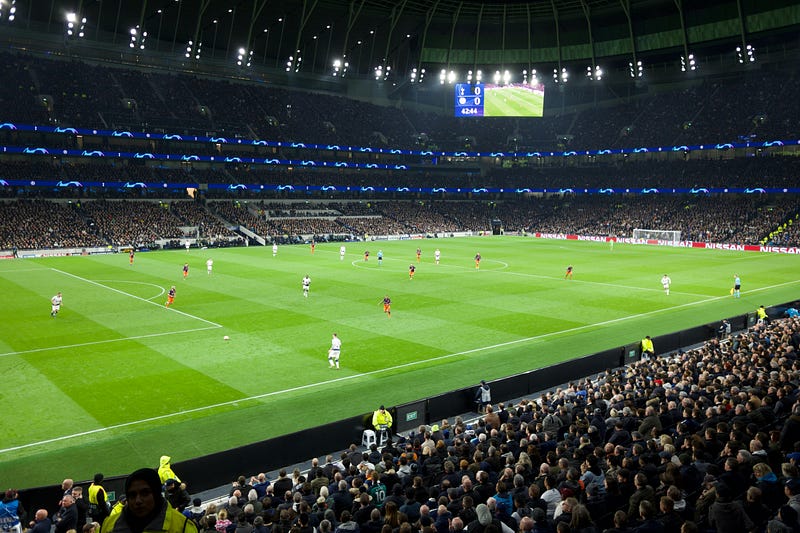
The UEFA Champions League, one of the most prestigious tournaments in club football, showcases a high level of competition and skill, drawing attention from millions of fans worldwide. The final match of this tournament, often featuring the best teams from across Europe, is a culmination of talent, strategy, and endurance. These matches not only crown the champions of European football but also serve as a fertile ground for analyzing various aspects of the sport, from player performance to team dynamics.
The role of player experience, especially in high-pressure situations like the Champions League finals, is an area ripe for exploration. Conventional wisdom suggests that experience, particularly in high-stakes matches, can be a critical factor in achieving success. However, the quantifiable impact of such experience on match outcomes has not been extensively explored. This study aims to bridge this gap by quantitatively examining how a team’s collective experience in previous finals influences its chances of winning the Champions League.
The focus of this research is twofold: to analyze the difference in the number of previous finals won by players and the difference in their overall finals appearances between the finalist teams. By examining the comparative experience of competing teams, the study seeks to uncover whether a relative experience advantage correlates with a higher probability of winning. This approach provides a nuanced perspective, acknowledging that both finalist teams often possess a mix of experienced and less experienced players.
The relevance of this study lies in its contribution to the ongoing discourse surrounding team dynamics and success factors in high-level football. While it may not fill a significant gap in existing research, it offers a unique perspective by focusing on the comparative experience of players in one of the most high-profile football tournaments. This exploration is particularly valuable for academic purposes, serving as a practical application of statistical analysis techniques in sports research.
Through this investigation, the study aims to enhance the understanding of factors that contribute to a team’s success in the Champions League finals, potentially offering insights useful for coaches, players, and analysts alike.
Methodology
Data Collection
The dataset for this study specifically focuses on the UEFA Champions League finals from 1993 onwards, a period following the rebranding of the competition from its previous format as the European Cup. This time frame was selected due to the availability and accessibility of data. The relevant data, obtained from an official UEFA Champions League document available at UEFA Editorial, included details such as the names of the finalist teams, the outcomes of each final, and the lists of participating players.
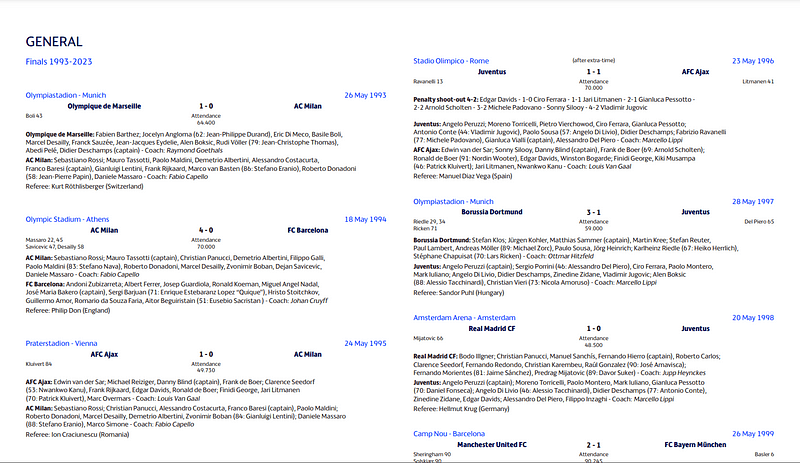
Importantly, player experience in finals prior to 1993 was not included in this analysis due to limited data availability from the European Cup era.
Data Preparation and Analysis
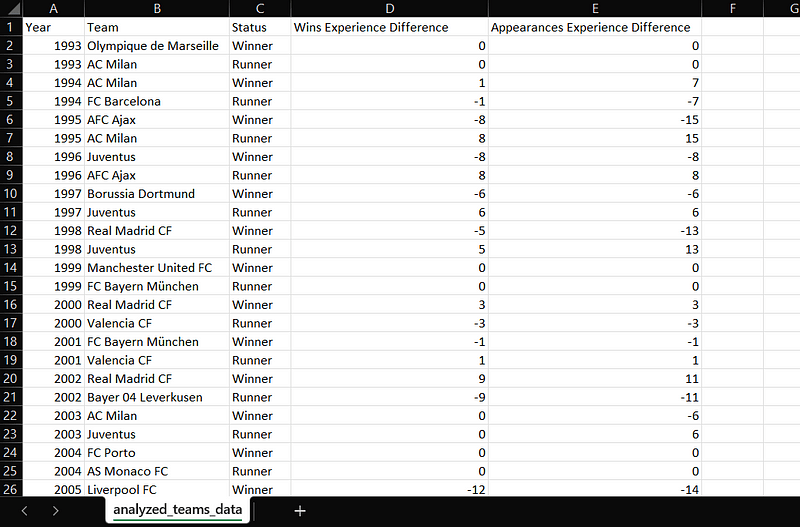
The extracted data was manually transcribed into a text file and processed using Python. The cleaning process involved standardizing player names and structuring the data appropriately for analysis. The key variables calculated were the differences in the number of previous finals won and the number of previous finals appearances between the teams reaching the final each year. These measures provided a comparative assessment of the experience levels of the competing teams.
The relationship between these experience metrics and the probability of winning the final was examined using point-biserial correlation analysis. This method was chosen for its suitability in studying the association between continuous and binary variables.
Software and Tools
Python and its libraries, including Pandas for data handling and SciPy for statistical analysis, were employed to process and analyze the data. This choice of software ensured efficient handling of the dataset, enabling rigorous and reproducible analysis.
Results
The point-biserial correlation analysis conducted in this study provided insights into the relationship between a team’s Champions League finals experience and their likelihood of winning.
The analysis revealed a correlation coefficient of 0.170 between the difference in the number of previous winners on each team and winning the final, with a p-value of 0.186. This suggests a weak positive correlation, indicating that having more previous winners in a team is weakly associated with an increased probability of winning the final. However, the p-value exceeds the conventional threshold for statistical significance (0.05), implying that this relationship is not statistically significant.
Furthermore, the difference in the number of previous finals appearances (excluding wins) between the competing teams showed an even weaker correlation with a coefficient of 0.007 and a p-value of 0.959. This negligible correlation coefficient, coupled with a high p-value, indicates no meaningful statistical relationship between this measure of experience and the likelihood of winning the final.
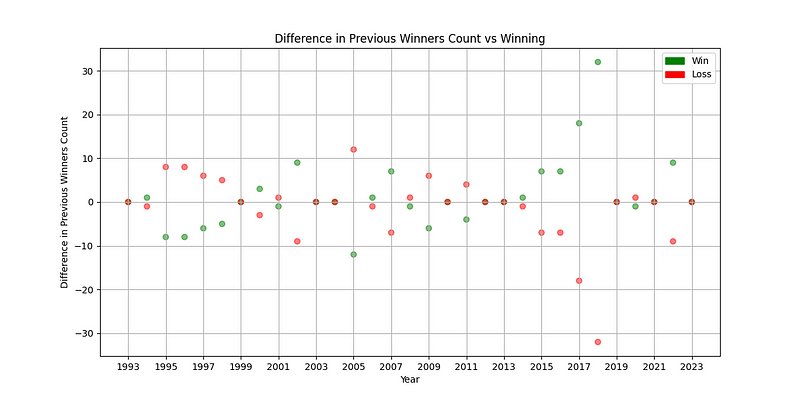
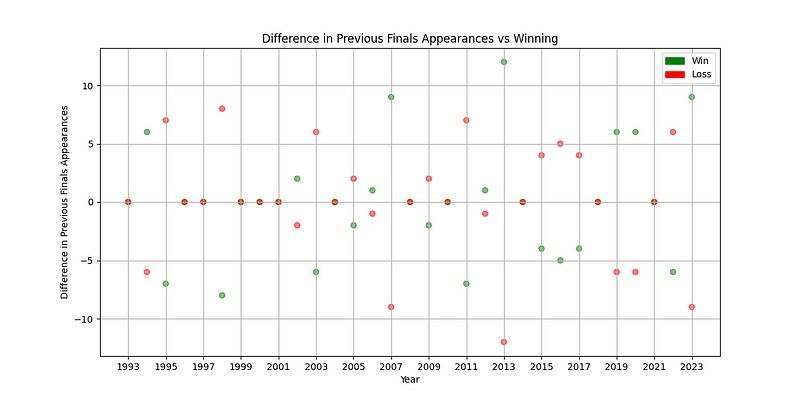
These scatter plots visually represent the relationships analyzed, with each point depicting a Champions League final. The points are colored to indicate whether the team with the greater experience advantage won (green) or lost (red) the final.
Discussion
The results of this study indicate a weak positive correlation between the experience of players in previous Champions League finals and the likelihood of their team winning. However, these correlations were not statistically significant. This suggests that while experience in finals may have some influence, it is not a predominant factor in determining the outcome of the final.
Contrary to perhaps a more intuitive expectation, the mere accumulation of experience in previous finals, whether victorious or not, does not strongly predict future success in these high-stakes matches. This finding contributes to the ongoing discourse on the factors that influence team success in professional football, highlighting that player experience in finals, while valuable, might not be as critical as other factors such as team strategy, current form, or psychological preparedness.
One limitation of this study is the scope of data, which only considers finals since the Champions League was rebranded in 1993 and does not account for experience gained in the competition’s previous format as the European Cup. Additionally, the study focuses solely on quantitative measures of experience and does not account for qualitative aspects, such as the intensity or role in previous finals.
Future research could expand on this work by including a broader historical scope, incorporating data from the European Cup era, or exploring qualitative aspects of player experience. Moreover, integrating additional variables such as team tactics, player positions, or psychological factors could provide a more comprehensive understanding of what drives success in Champions League finals.
References
UEFA Editorial. (2023). UEFA Champions League Finals Data. Retrieved from https://editorial.uefa.com/resources/0282-18407a7a3056-fed61d05639b-1000/ucl_202223_finals_md13.pdf
Python Software Foundation. (2023). Python Documentation. Retrieved from https://www.python.org/doc/
McKinney, W. (2010). Data Structures for Statistical Computing in Python. Proceedings of the 9th Python in Science Conference.
Jones E., Oliphant, T., Peterson, P., et al. (2001). SciPy: Open Source Scientific Tools for Python. Retrieved from https://www.scipy.org/
 Sidharth Suresh
Leave a comment